
October 27, 2026
I hear it all the time.
“Sorry to bother you…”
“Sorry, can I ask a question?”
“Sorry, but I have a different opinion.”
“Sorry, I just wanted to add something.”
And every time I hear it, I wonder: What exactly are you apologizing for? Asking a question? Having an opinion? Taking up a little space in the conversation?
There are absolutely times when we should apologize. In fact, a sincere apology can be one of the most powerful relationship-building tools we have. But saying “sorry” and offering a meaningful apology are not the same thing.
When “Sorry” Becomes a Habit
For many of us, “sorry” has become conversational filler. We use it to soften a request. We use it when we disagree. We use it before offering an idea. Sometimes we even apologize for circumstances completely outside our control.
Why?
Maybe we want to be polite. Maybe we’re trying to avoid conflict. Maybe we don’t want to appear demanding. Or maybe we’ve said it so often that we don’t even notice anymore. But here’s the challenge. When you continually apologize when you haven’t done anything wrong, you can unintentionally minimize yourself and your message.
Consider the difference:
“Sorry to bother you, but could you look at this?”
versus
“When you have a few minutes, I’d appreciate your perspective on this.”
Or:
“Sorry, but I disagree.”
versus
“I see this differently. Can I share another perspective?”
Same intention. Very different energy.
You don’t have to apologize for contributing to the conversation.
 |
When an Apology Is Needed
Now, let’s flip this around. If you have made a mistake, hurt someone, broken a commitment, or created an impact you didn’t intend, don’t avoid the apology. Own it.
A real apology isn’t simply saying, “I’m sorry.” It requires accountability.
It might sound like:
“I realize I interrupted you several times in that meeting. I can see how that made it difficult for you to contribute, and I apologize. I’m going to be more conscious of giving you space to finish your thoughts.”
Notice what happened there? I didn’t defend my intention. I acknowledged my impact.
That distinction matters. We can have the best intentions in the world and still negatively impact another person. Strong relationships require us to be willing to recognize both.
Don’t Dilute the Real Thing
This is one reason I think we should be more thoughtful about when we use the word “sorry.” If we’re apologizing all day long for asking questions, entering rooms, sending emails, disagreeing, or needing something, the word starts to lose its power.
Save your apologies for the moments that deserve them. And when those moments happen, make them count.
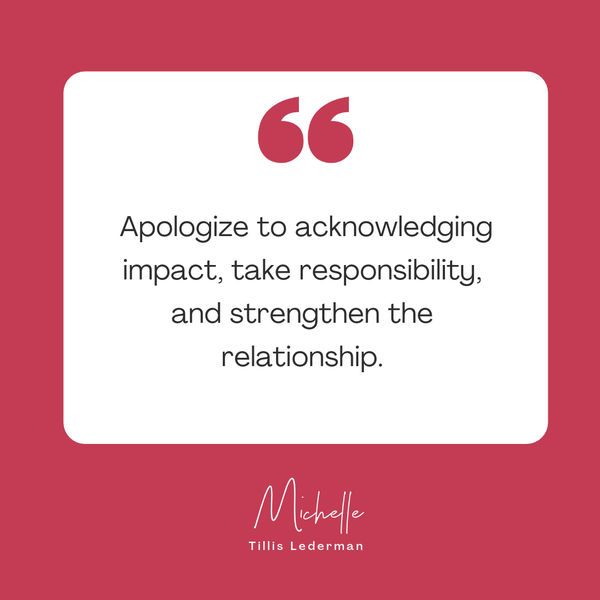
A meaningful apology says:
- I understand what I did.
- I recognize how it affected you.
- I take responsibility for my part.
- Here’s what I’ll do differently.
That’s not weakness. That’s relationship repair.
And for leaders especially, that’s important. Leadership is about achieving results with and through other people, which means we will inevitably make mistakes in those relationships. What matters is what we do next.
Try This for a Week
Here’s my challenge for you. For the next week, notice every time you say or write the word sorry.
Don’t necessarily stop yourself. Just get curious and ask: Did I actually do something that requires an apology?
If the answer is no, what did you really mean?
Maybe it’s:
- “Excuse me.”
- “Thank you for waiting.”
- “I appreciate your flexibility.”
- “I have a different perspective.”
- “Could I ask you something?”
Or perhaps you don’t need a replacement at all.
And if the answer is yes—if an apology really is warranted—don’t toss out a quick “sorry” and move on. Take responsibility. Acknowledge the impact. Say what you’ll do differently.
Because we don’t need to apologize for having a voice, asking for what we need, or taking up appropriate space. But when our actions affect someone else, that’s when an apology has the power to strengthen the relationship.
Say “sorry” less automatically. Apologize more intentionally.